Wheelchair
via Motor Imagery.
When someone imagines moving their feet or a hand, the brain produces measurable electrical patterns even when the body can't follow through. A non-invasive EEG headset picks up those patterns, and the system translates them into driving commands.
Rather than building a specialized wheelchair from scratch, the add-on works with the chair a person already owns. This keeps the cost low and avoids the need for a new purchase, permanent modification, or surgery.
In practice, the user wears an EEG headset and simply imagines a movement. Imagining foot movement drives the chair forward, imagining a hand movement rotates it, and relaxing brings it to rest. The sections below describe how the current prototype implements this.
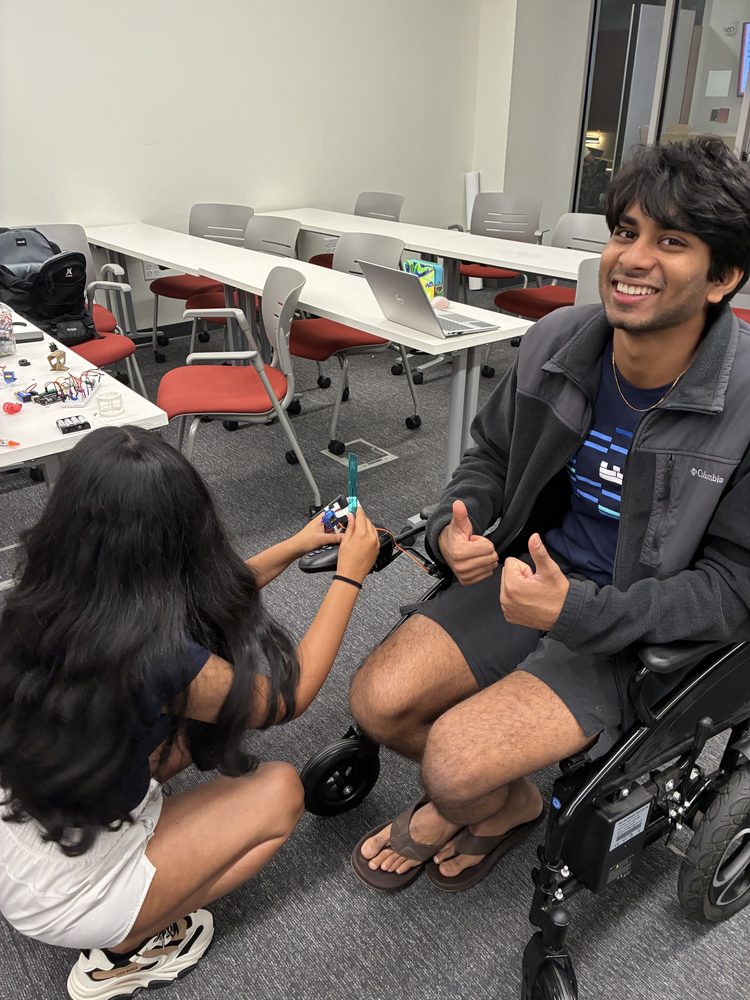
The add-on sits on top of most electric wheelchair joysticks rather than requiring direct wiring to a specific model, making it adaptable across chair types.
The initial prototype uses three classes: feet (forward), right hand (rotate right), and rest. This is a deliberate choice to minimize system complexity and prioritize a functional, usable prototype over premature feature expansion. The final product will allow the user to either choose which hand should be used to rotate the wheelchair, or to use both hands to rotate on both sides: feet (forward), right hand (rotate right), left hand (rotate left), and rest.
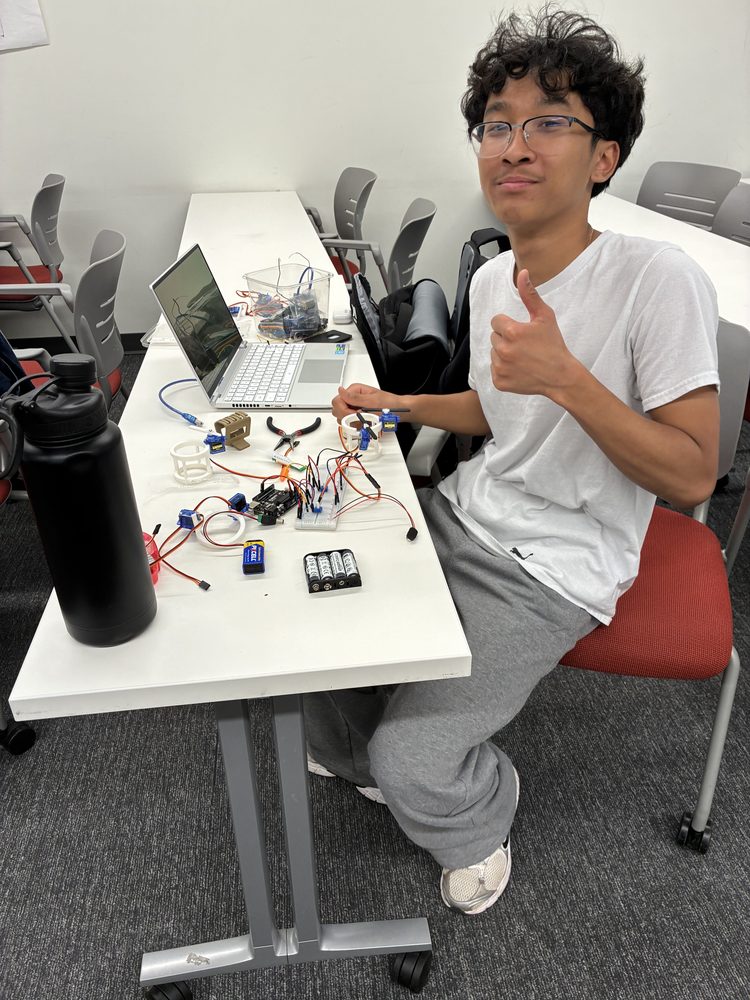
The mechanical interface is a cap that mounts over the joystick. When a command is decoded, servos driven by the Arduino push the cap to move the joystick in the intended direction. The chair's own electronics are never touched, so the original joystick controls remain available.
This is the software that learns to recognize each user's imagined movements from their EEG signal. It starts with simple, well-understood methods and benchmarks against MOABB (Mother of All BCI Benchmarks) for standardized comparison. Complexity is added only when the data demands it.
We begin with conventional classification models such as LDA and SVM with CSP features, as they are lightweight and predictable. If these hit a wall in accuracy, we will move to deep learning approaches like CNNs or transformers.
The system has two main pieces of hardware: a non-invasive EEG headset worn by the user, and the add-on unit mounted on the wheelchair.
The headset records the brain's electrical activity while the user imagines movements. The add-on unit turns decoded commands into physical motion. An Arduino runs the firmware that receives each command and drives small servos, which move the cap mounted on the joystick. Because the add-on sits on top of the joystick rather than wiring into the chair, it adapts across chair types and leaves the original controls intact.
A working proof of concept exists. Imagined movement, decoded from EEG, physically actuated the joystick hardware in an end-to-end demonstration.
The first prototype paired a crude classification model with Arduino firmware. The model reached 70% accuracy on the training dataset, and the firmware translated its output into servo movement on the joystick, completing the loop from brain activity to physical motion.
The long-term goal is a chair that feels natural to drive, reliable enough for daily use in hallways, grocery stores, and campus sidewalks. Getting there means moving from single, discrete commands toward smooth, continuous control.
The immediate goal is to allow continuous input alongside discrete commands. For example, a single command to go forward by 8 feet rather than four separate commands of 2 feet each.
Why develop BCI when there are already many other established ways to control a wheelchair?
For users who cannot operate a hand joystick, the established alternatives are sip-and-puff and chin joysticks, the two most popular control methods in use after the hand joystick. Across the four prevalence studies reviewed by Henderson et al. [1], sip-and-puff accounted for 4–8% of electrically powered wheelchair (EPW) users and chin or head control for 4–8%.
| Control device | Share of EPW users |
|---|---|
| Hand joystick | 84–92% |
| Sip and puff | 4–8% |
| Chin or head control | 4–8% |
| Other (switches, tongue, eye gaze) | ~1% |
These alternatives have limitations, and they leave a substantial share of users behind. Sip-and-puff is prone to false activation from shocks and vibration, for example when travelling over uneven ground [3]. It is also a latched control. Once a command is given, the chair keeps executing it until another signal is received, which can be hazardous if the user is inactive after initiating a command. Chin joysticks require good head and neck range of motion and strength, fatigue over long periods of use, and place hardware directly in front of the user's face [1]. The scale of the unmet need is significant. In one cohort of 64 EPW users, ten (16%) could no longer use their chair or were described as having great difficulty [1, section 3.1]. In a clinical survey of power wheelchair providers, 85% of respondents had evaluated patients for whom an EPW was not an option, due to lack of motor skills, strength, or visual acuity, and it was estimated that 18–26% of non-ambulant wheelchair users who could not self-propel a manual wheelchair were also unable to operate an EPW [2].
BCI is an emerging alternative for users who cannot operate the control methods that already exist. Non-invasive EEG requires no residual muscle control. The user imagines a movement, and the system decodes the intention from brain activity. Among BCI paradigms, motor imagery is a particularly natural fit for wheelchair control. Unlike P300 or steady-state visual evoked potential (SSVEP) paradigms, it does not require the user to stare at a blinking screen to issue commands, and because the imagined movement maps directly onto the wheelchair's motion, the mapping is intuitive. That is the gap this project addresses.
- Henderson GI, Dolan MJ, Geggie CJ. A review and appraisal of clinically prevalent control devices for electrically powered wheelchairs. Technology and Disability. 2013;25(4):221–232.
- Fehr L, Langbein WE, Skaar SB. Adequacy of power wheelchair control interfaces for persons with severe disabilities: A clinical survey. Journal of Rehabilitation Research and Development. 2000;37(3):353–360.
- Jones M, Grogg K, Anschutz J, Fierman R. A Sip-and-Puff Wireless Remote Control for the Apple iPod. Assistive Technology. 2008;20:107–110.